
Our Creative Industries Census 2026 found that already 65% of hard-to-fill vacancies are attributed to skills shortages, and that pressure is only set to increase. When technologies and tools develop faster than the people using them, it fractures the workforce’s ability to meet evolving expectations. That’s because, while investment in technological solutions has been significant, people have not received comparable capital support.
So what skills are employers actually looking for to make meaningful gains in a market that isn't slowing down?
AI ranks the highest
Across all the groups we surveyed, AI and technical proficiency consistently ranked as the #1 skill needed for the future of work. In other words, for creative and marketing professionals, incorporating AI tools into their process is no longer optional. Although our report found that the productivity gains are lagging behind adoption, these novel tools have already changed how creative briefs are approached and dissected.
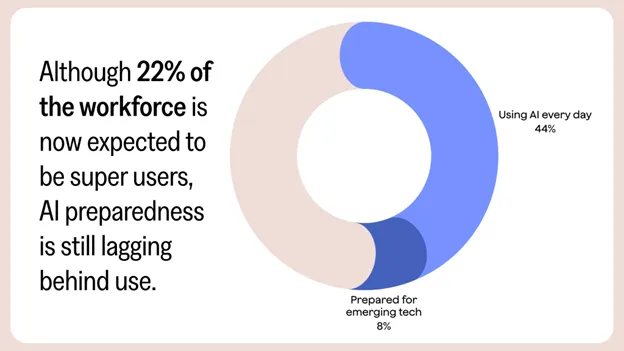
Yet despite 44% of the workforce already using AI every day, only 8% feel genuinely prepared for emerging technologies. This creates a clear opportunity for talent who are able to not only use AI, but can also co-create with these technologies and tools to create something meaningful. Those who can properly direct these tools are the profiles employers are actively looking for and struggling to find.
As AI continues to increase output, the ability to produce more will matter less than the ability to produce better. Producing content and campaigns that actually stand our will become the real measure of AI fluency.
Discipline-specific technical skills
Beyond AI skills, employers are becoming increasingly specific about the technical capabilities they need. That means more generalist profiles are losing ground.
Access to faster, more capable tools has raised the bar for what employers consider standard; what was once a specialism is now an entry-level expectation. That means the demand shifted to how well a candidate can use said tools. Depth of application is now what separates good from excellent, since those who understand the intricacies of the tools they work with can extract gains others would miss.
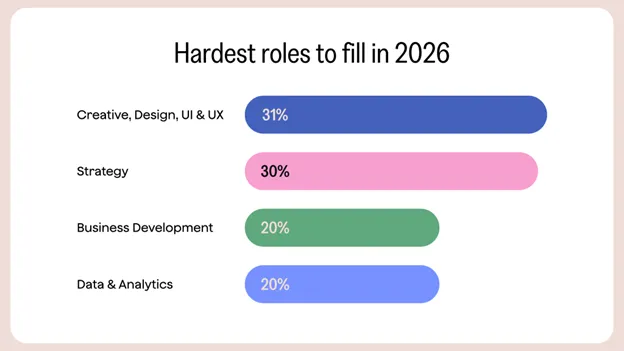
When asked which roles will be hardest to fill in 2026, clients were clear: Creative, Design, UI & UX (31%), Strategy (30%), and Business Development and Data & Analytics (20% each). These disciplines are evolving quickly, which means shallow knowledge rears its head more quickly.
In an increasingly competitive market, small gains add up. Employers are after talent that can squeeze more out of available tools to achieve seemingly incremental improvements.
Interpersonal skills still matter
Technical skills may be dominating the conversation, but increasingly, interpersonal skills are also being prioritised. Innate human capabilities that are the hardest to artificially replicate are still the ones most worth developing. Creativity and innovation, critical thinking and emotional intelligence are the most cited critical interpersonal skills across the workforce, with freelancers rating creativity highest of any group at 54%.
Thinking cannot be outsourced to AI. Because it’s human instinct and interpretation that give the output these tools produce any meaning. Even the most competent tools are still developed and deployed by people, largely for the benefit of people. That's why data from Upwork shows that 47% of business leaders would pay a premium to work with talent that is innovative, and 45% would pay more to work with talent that is creative.
As AI-generated content increases in volume and audiences grow more discerning, the ability to bring human connection and judgment to creative work is becoming more important albeit more difficult to quantify. That means both candidates and employers need to consider what is the thinking that produces impactful work.
Blending it up
Increasingly, the most valuable professionals are not those who have mastered one thing, since the skills highest in demand will continue to change. The most desired candidates will be the ones who combine knowledge of how these emerging technologies function with an understanding of how they partner with human ingenuity in their specialism.
As tools take on more of the executional workload, role boundaries will become increasingly fluid - defined less by traditional job titles and more by capability and adaptability. Moving across boundaries with confidence will become a standard expectation. And since 69% of businesses expect their workforce to upgrade skills to keep pace with new technologies, there is a clear opportunity for professionals willing to go deep, stay curious and be flexible.
The skills landscape is shifting faster than most businesses are moving, and the gap between what employers need and what the market can offer is only widening. Staying ahead means being honest about where the gaps are. Now’s the time to invest in new skills before they become baseline, demonstrate the thinking behind the work, and treat creativity, critical thinking and emotional intelligence as seriously as any technical capability.
Understanding where the market is heading is something we at Major Players track closely. Our Creative Industries Census 2026 gives both clients and candidates the clearest possible picture of where the market stands right now, so that decisions about where to go next are grounded in the transformative power of data.
Download the full report for the full picture: https://www.majorplayers.co/en/the-creative-industries-census


.webp)